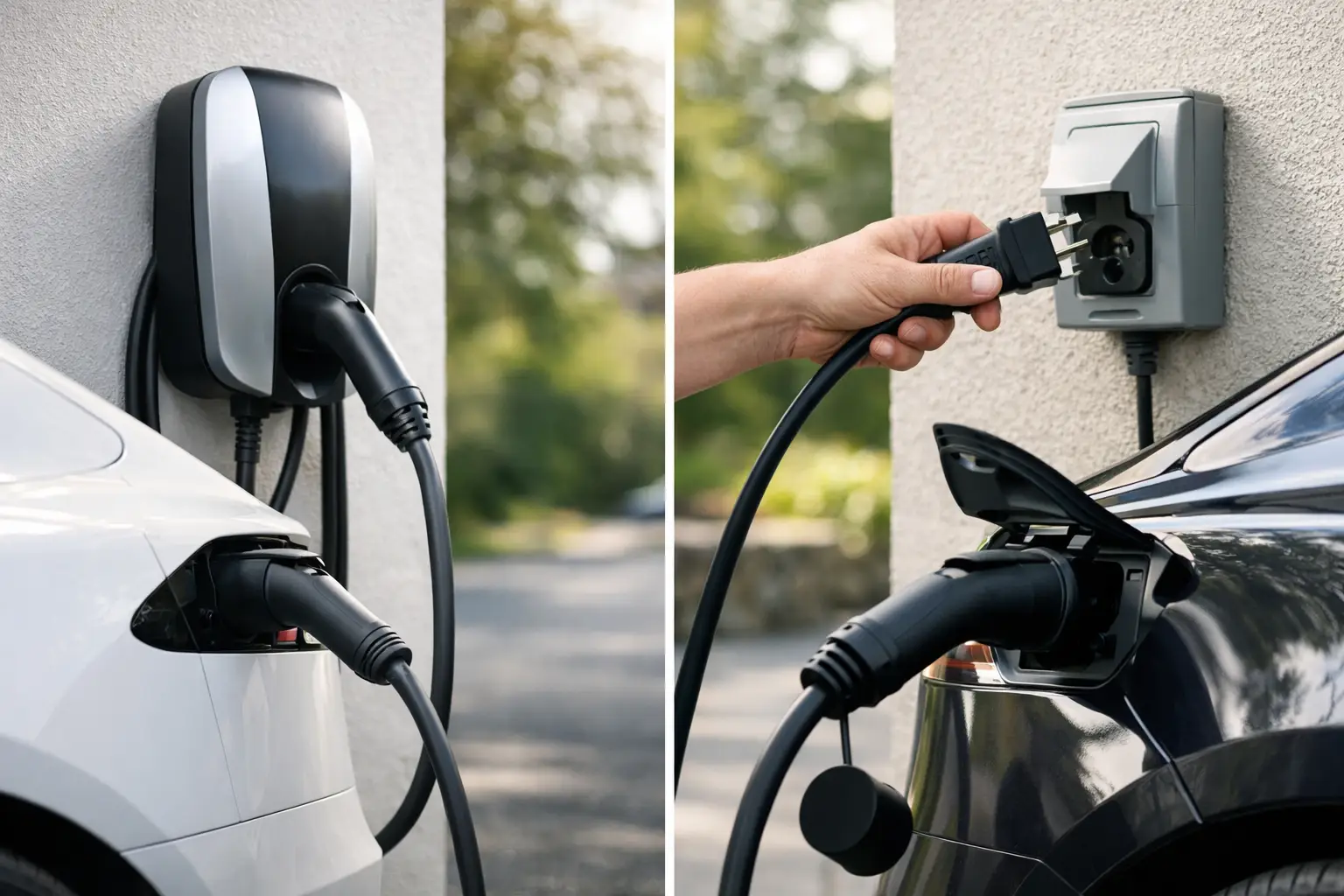
A Level 2 charger can make EV ownership far more practical, but the charger itself is only part of the decision. When comparing hardwired versus plug EV chargers, the right choice depends on the charger’s output, your electrical panel capacity, where it will be installed, and whether flexibility matters more than a permanent setup.
For many Raleigh-area homeowners, either option can work well when installed correctly. The key is not choosing based on convenience alone. EV charging is a long-duration electrical load, so the circuit, wiring method, breaker size, receptacle or connection, and installation location all need to work together.
Hardwired versus plug EV chargers: the main difference
A hardwired EV charger connects directly to a dedicated circuit. There is no wall receptacle between the electrical wiring and the charging equipment. An electrician mounts the charger, runs the properly sized conductors from the panel, and makes the final connection inside the unit or a nearby disconnect where required.
A plug-in charger connects to a dedicated receptacle, most often a 240-volt outlet such as a NEMA 14-50 or 6-50. The charger plugs into that outlet much like a large appliance. The receptacle, plug, and charger cord are all part of the charging setup.
Neither approach is automatically right for every property. A plug-in unit can be a sensible choice for a homeowner who may move, replace equipment, or use the outlet for another approved purpose. A hardwired unit is often the better fit when higher charging output, a cleaner permanent installation, or outdoor durability is the priority.
Why hardwired chargers are often chosen for permanent installations
Hardwired chargers are common in garages, carports, driveways, and commercial parking areas because they eliminate one connection point: the receptacle and plug. Fewer components can mean less opportunity for wear, loose contacts, or heat buildup over years of regular charging.
They also support higher charging rates on many models. For example, some hardwired Level 2 chargers can deliver up to 48 amps, which generally requires a 60-amp dedicated circuit. Many plug-in charger configurations are limited to 40 amps on a 50-amp circuit because the plug and receptacle arrangement set practical limits. The charger manufacturer’s instructions and the electrical code requirements always control the final design.
A hardwired installation usually looks more finished as well. The charger can be mounted at the preferred height, conduit can be routed cleanly, and the cable can be managed so it is not lying across the garage floor or driveway. For a visible exterior installation, that clean layout matters.
When hardwiring makes the most sense
Hardwiring is typically a strong option when the charger will stay with the property, when a homeowner wants the highest available output from a compatible charger, or when the equipment is mounted outdoors. It is also often preferable for commercial charging equipment, where reliability, coordinated installation, and protection from daily use are major concerns.
It does mean the charger is not as simple to take with you if you move. Removing or replacing a hardwired unit should be handled by a qualified electrician, especially if the circuit needs to be reconfigured for new equipment.
When a plug-in EV charger is the practical choice
A plug-in charger offers flexibility. If the charger fails, is upgraded, or is needed at another property, it can be unplugged without opening the electrical equipment. Some EV owners also prefer a plug-in unit because the outlet may support a portable charging cord for travel or serve a future charger model with the same plug configuration.
That convenience does not make the installation casual. A standard household outlet is not suitable for Level 2 EV charging. The receptacle must be on a dedicated circuit sized for the charger’s continuous load, installed in the correct location, and rated for the demands of repeated charging. A low-cost receptacle that sees daily high-amperage use can loosen or overheat over time.
For a plug-in charger, the receptacle choice is just as important as the charger choice. Heavy-duty receptacles designed for EV charging or similar continuous-duty use are a better fit than basic residential-grade devices. The enclosure, cover, wiring, breaker, and conductor size also need to match the environment and electrical load.
A plug-in setup is not always less expensive
The charger may be easier to swap later, but the electrical installation can cost about the same as hardwiring once the dedicated circuit, conduit, permits, and panel work are considered. In some cases, adding a quality receptacle, enclosure, and required protection may narrow the price difference significantly.
The right question is not simply, “Which one costs less?” It is, “Which installation gives this property the right balance of capacity, reliability, and future flexibility?”
Charging speed is only one part of the decision
It is easy to focus on amps, but most drivers do not need the fastest charger available. A 32-amp or 40-amp Level 2 charger can fully support typical overnight home charging for many vehicles. If the vehicle is parked for eight to ten hours, a moderate charging rate may be more than enough for daily driving.
Higher output becomes more valuable when a household has multiple EVs, drivers return home late and leave early, or the vehicle needs meaningful range added during the day. Commercial properties may also need faster charging depending on fleet schedules, employee use, visitor demand, or tenant expectations.
The electrical panel has a say in this decision. A 60-amp circuit may be possible in one home but not another without a load calculation, panel upgrade, or service upgrade. Existing major loads such as HVAC equipment, electric water heaters, ranges, dryers, pools, and workshops all affect available capacity.
A licensed electrician should evaluate the panel rather than assuming an open breaker space means enough power is available. Physical space in the panel and electrical capacity are two different things.
Installation location changes the requirements
A garage installation is usually more straightforward than an exposed driveway or commercial parking lot, but every location requires planning. Charger placement should account for the vehicle’s charge port location, cord reach, mounting surface, parking patterns, and protection from impact.
For outdoor installations, the charger and all associated equipment must be rated for the environment. Conduit routing, weatherproof boxes, proper fittings, equipment clearances, and protection from vehicle contact all matter. A charger mounted where a car door, lawn equipment, or a parking maneuver can strike it may need added protection.
In a commercial setting, the plan may also include trenching, conduit runs, equipment power, access control, signage, bollards, and coordination with property management or tenant operations. A well-planned installation keeps the charging equipment useful without creating a maintenance issue or interrupting daily business activity.
What a proper EV charger installation should include
Whether the charger is hardwired or plug-in, the installation should begin with the equipment specifications and the property’s electrical conditions. The charger’s maximum output determines the circuit requirements, and EV charging is treated as a continuous load. That means the circuit must be sized with appropriate capacity rather than matched one-for-one with the charging amperage.
The work should include a dedicated circuit, correctly sized conductors, an appropriately rated breaker, secure equipment mounting, and a final test of the charger and vehicle connection. Permitting and inspection requirements should be addressed where applicable. If the existing panel is crowded, outdated, or short on capacity, the installer should explain the options before work begins.
Clear communication is especially valuable here. A homeowner should know where the charger will be mounted, what will be visible after the work is complete, whether surface conduit is needed, and whether a panel upgrade or additional electrical work may affect the schedule or cost.
Choosing the setup that fits your property
Choose a hardwired charger if you want a permanent, clean installation, need higher output from compatible equipment, or are installing charging infrastructure outdoors or for a business. Choose a plug-in charger if equipment portability and simple replacement matter most, provided the receptacle and dedicated circuit are designed for regular EV charging.
For either setup, avoid treating the charger as a simple outlet addition. The best installation is the one that fits the vehicle, the building, and the way charging will actually happen. A properly planned dedicated circuit protects the equipment, supports reliable charging, and leaves your garage, driveway, or facility ready for the miles ahead.