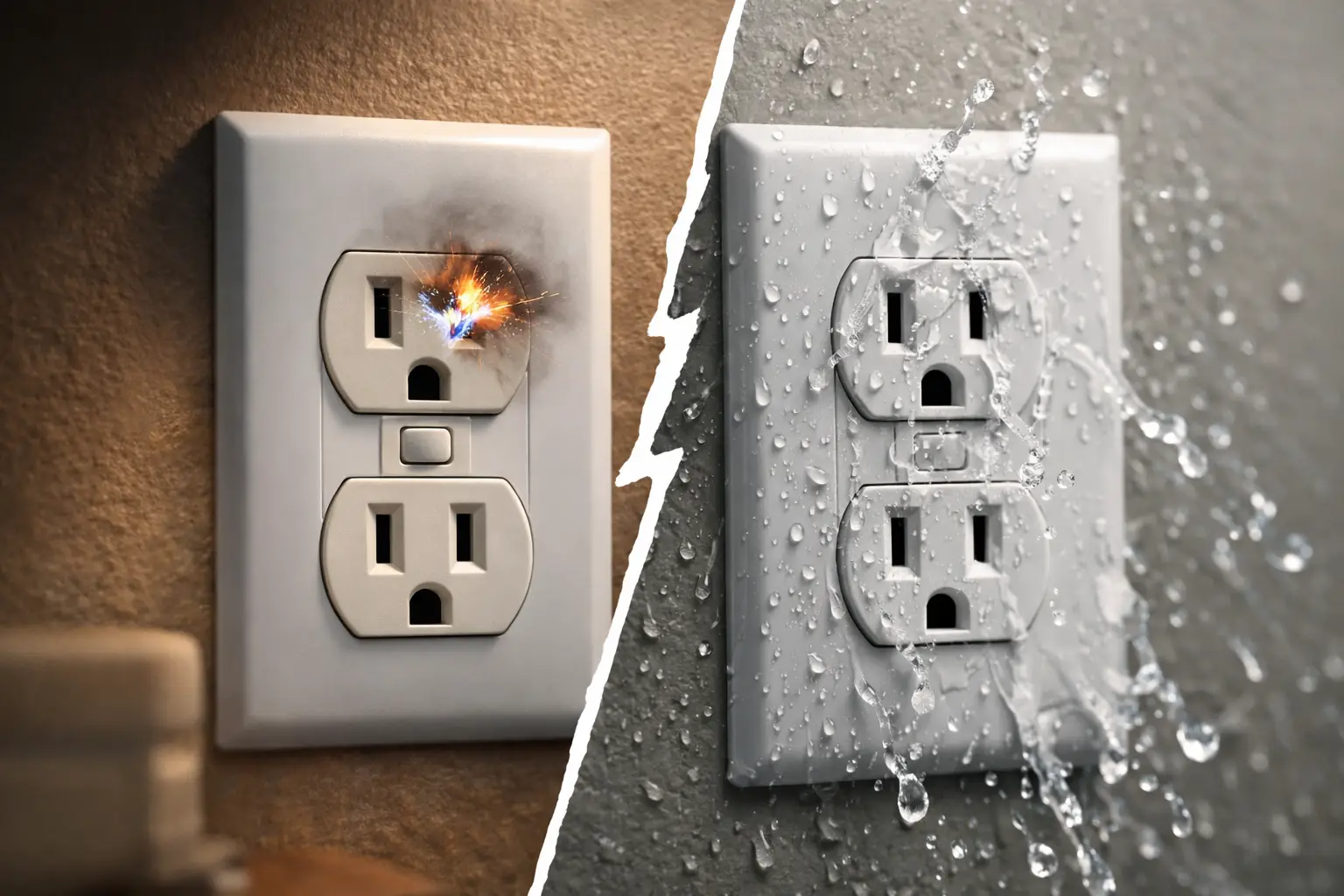
A breaker trips when you plug in a vacuum. A bathroom outlet will not reset. Or a home inspection report calls for AFCI and GFCI protection, leaving you to wonder whether they are the same thing with different labels. They are not. AFCI vs GFCI outlets is really a question of two different electrical hazards: fire caused by arcing and shock caused by current traveling where it should not.
Both protections are valuable, and many modern circuits need both. The right answer depends on the circuit, the equipment connected to it, the age of the electrical system, and the code requirements that apply to the work being done.
AFCI vs GFCI Outlets: The Core Difference
A GFCI, or ground-fault circuit interrupter, is designed to reduce the risk of electric shock. It continuously compares the electricity leaving on the hot conductor with the electricity returning on the neutral conductor. If even a small amount takes an unintended path – potentially through water, a metal fixture, or a person – the device shuts the circuit off quickly.
That is why GFCI protection is common where water or damp conditions are part of normal use. Bathrooms, kitchens, garages, exterior receptacles, crawl spaces, unfinished basements, laundry areas, and locations near sinks often require it under modern electrical codes. The exact requirement can vary with the adopted code and the details of the space.
An AFCI, or arc-fault circuit interrupter, addresses a different problem. An arc fault can occur when a damaged conductor, loose connection, pinched cable, worn cord, or failing device allows electricity to jump across a gap. That arcing can create substantial heat and sparks without necessarily drawing enough current to trip a standard breaker. AFCI protection recognizes the electrical pattern associated with hazardous arcing and disconnects power before the fault can become a fire risk.
A simple way to remember the distinction is this: GFCI protection is primarily about shock hazards, while AFCI protection is primarily about fire hazards. Neither is a substitute for the other.
Are They Actually Outlets?
Homeowners often call any protective device an outlet, but the protection may be located in more than one place. A GFCI receptacle has the familiar TEST and RESET buttons on its face. It can protect itself and, when wired correctly, additional receptacles downstream on the same circuit.
AFCI protection is often provided by a breaker in the electrical panel rather than by a receptacle. AFCI receptacles are available, but they are usually used for specific repair or retrofit situations where replacing the breaker is not practical or where code allowances permit their use. A dual-function AFCI/GFCI breaker provides both forms of protection from the panel.
That distinction matters during troubleshooting. A kitchen counter receptacle may not have reset buttons because its GFCI protection could be at another receptacle, at the panel, or combined with AFCI protection in a dual-function breaker. Resetting the wrong device will not restore power.
Where Each Type of Protection Is Commonly Needed
GFCI protection follows the possibility of shock exposure. Water increases the likelihood that a person can become part of an unintended electrical path, but GFCI requirements are not limited to visibly wet areas. Garages, outdoor spaces, unfinished areas, and certain appliance locations are also common examples.
AFCI protection is commonly associated with living spaces where cords, furniture, wall fasteners, aging receptacles, and concealed wiring can create arc-fault conditions. Bedrooms were among the earliest areas to receive AFCI requirements, but current code requirements generally cover many 120-volt, 15- and 20-amp circuits supplying dwelling-unit living areas.
Kitchens are a good example of why the two devices are frequently confused. Countertop receptacles often need GFCI protection because of their proximity to sinks and food preparation. Depending on the circuit and local code requirements, that same circuit may also require AFCI protection. In many installations, a dual-function breaker is the cleanest way to provide both.
Bathrooms typically call for GFCI protection. AFCI requirements may differ based on the circuit arrangement, the adopted electrical code, and whether the work is new construction, a remodel, or a repair. A licensed electrician should evaluate the specific circuit instead of applying a blanket rule from an online chart.
When a Home May Need Both AFCI and GFCI Protection
Both protections are common in newer homes, renovations, panel upgrades, and circuits extended during a remodel. They can also become relevant when an inspector identifies an issue or when electrical work triggers code requirements for the portion being altered.
However, adding protection is not always as simple as swapping a breaker. Older homes may have shared neutrals, wiring defects, improper grounding, multi-wire branch circuits, or panel equipment that is not compatible with modern breakers. These conditions can cause a new AFCI or GFCI device to trip, but the trip is not automatically a nuisance.
A protective device that trips repeatedly may be identifying a loose splice, damaged cable, moisture intrusion, a failing appliance, an overloaded circuit, or a neutral-to-ground connection downstream. The device is doing its job by responding to something outside normal operation. The goal is to find the cause, not remove the protection so the circuit stays on.
What to Do When an AFCI or GFCI Trips
Start by identifying what lost power. Check the electrical panel for a tripped breaker, then look for GFCI receptacles nearby and in adjacent spaces. A bathroom GFCI can sometimes protect another bathroom, a garage receptacle, or an exterior outlet. Press RESET firmly only after unplugging appliances on the affected circuit.
If the device resets and holds, reconnect equipment one item at a time. A single appliance, cord, power strip, disposal, refrigerator, sump pump, or outdoor item may be the problem. If it trips again with nothing connected, do not keep forcing resets. That points more strongly to a wiring issue, moisture, or a failed protective device.
AFCI trips can be more complicated because the source may be a loose termination inside a box, a damaged extension cord, a faulty switch, or wiring hidden behind a wall. Professional diagnostic work can isolate the circuit, inspect connections, test equipment, and correct the actual fault without unnecessary disruption.
Can You Replace a Standard Outlet With a GFCI Yourself?
Replacing a receptacle looks straightforward, but GFCI wiring has a critical distinction between LINE and LOAD terminals. Reversing those connections can leave the device energized without providing downstream protection as intended. Older wiring may add further complications, especially if the box has no equipment grounding conductor or contains multiple circuits.
Panel work carries greater risk. Installing an AFCI or dual-function breaker requires correct breaker compatibility, proper neutral routing, accurate circuit identification, and safe work inside energized equipment. A breaker that fits physically is not necessarily approved for the panel. Mixing brands or using the wrong breaker type can create safety and reliability problems.
For a simple, known receptacle replacement, some homeowners may be comfortable working only after power is fully shut off and verified. For recurring trips, uncertain wiring, panel changes, added circuits, remodel work, or any commercial application, licensed electrical service is the better path. It protects people, property, and the reliability of the electrical system.
Testing and Maintaining Protection Devices
GFCI receptacles and breakers have a TEST button for a reason. Pressing it should interrupt power, and RESET should restore it. Testing periodically helps confirm that the mechanism can respond when needed. If a device will not test, will not reset, feels warm, has discoloration, or makes noise, it should be evaluated promptly.
AFCI breakers also have test functions, although testing and interpreting a result can vary by manufacturer and breaker type. Do not assume a breaker is defective simply because it trips during normal use. First consider recently added equipment, damaged cords, loose plugs, or changes to the circuit.
For property owners and facility managers, protective-device issues should be handled before they become disruptions. A tripping circuit in a break room, restroom, tenant space, equipment area, or exterior location can affect operations as well as safety. Clear circuit labeling and prompt diagnostics make future service faster and reduce avoidable downtime.
AFCI and GFCI protection are not competing choices. They are separate safeguards that often work together. When a circuit trips, treat it as useful information, get the cause identified, and restore power with the protection the circuit is meant to have.