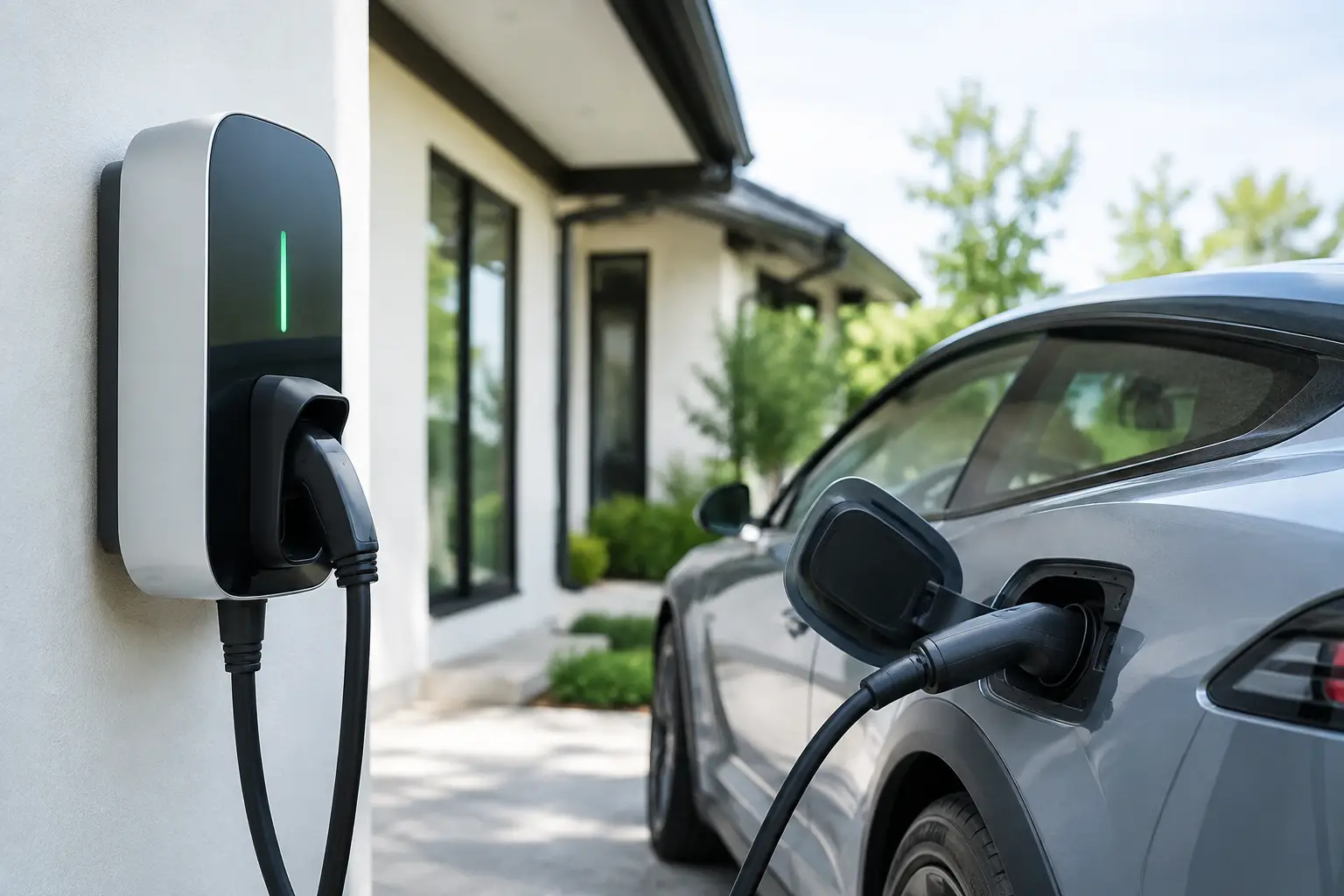
A Level 2 charger can add more power to your vehicle in a few hours than a standard wall outlet delivers overnight. That convenience is exactly why the top EV charger safety features deserve a close look before installation. The charger, the dedicated circuit, the panel capacity, and the installation details all need to work together.
For homeowners and property managers, safety is not just about buying a charger with a recognizable name. It is about making sure the equipment is listed for its intended use, sized correctly for the electrical system, and installed cleanly by a licensed electrician. A charger with good built-in protections cannot compensate for an undersized circuit, loose termination, or overloaded panel.
Top EV Charger Safety Features to Look For
Ground-fault protection
EV charging equipment should be able to detect an unintended path for electrical current and stop charging when that condition occurs. This is commonly referred to as ground-fault protection. It helps reduce shock risk if current begins flowing where it should not, such as through damaged equipment, moisture, or a fault in the charging cable.
Many modern EV chargers include ground-fault monitoring as part of their internal safety system. The branch circuit may also require ground-fault protection depending on the equipment, location, and applicable electrical code. An electrician should verify how the charger manufacturer’s instructions and local requirements apply to the installation rather than assuming one layer of protection replaces another.
Overcurrent protection and a properly sized circuit
A Level 2 charger needs a dedicated circuit with a correctly sized breaker, conductors, and equipment connections. The breaker is there to interrupt power if the circuit draws more current than it can safely handle. It is a basic protection, but it only works as intended when every part of the circuit has been designed for the load.
EV charging is generally treated as a continuous load because it can run for several hours. That means the circuit must be sized with the proper margin. For example, a charger set to deliver 32 amps typically requires a 40-amp circuit. Selecting a larger breaker to stop nuisance trips is not a fix. It can allow wiring or connections to overheat before the breaker responds.
Temperature monitoring
Heat is one of the clearest warning signs in electrical work. Quality EV charging equipment may monitor internal temperatures and reduce output or shut down if it detects excessive heat. Some chargers can also identify abnormal heat at the plug or connector.
This protection is valuable, particularly for plug-in chargers, but it does not make a worn or poorly installed receptacle safe. A loose terminal, damaged outlet, or low-quality receptacle can create heat at the connection point. When a charger will be used frequently at higher amperage, a hardwired installation often eliminates one potential failure point. The right choice depends on the charger, the planned load, and whether future equipment changes are likely.
A listed enclosure and weather rating
Indoor and outdoor chargers face different conditions. A garage installation may need protection from impact, dust, and vehicle traffic. An exterior installation must also stand up to rain, humidity, temperature swings, and sunlight.
Look for equipment listed by a recognized testing laboratory and rated for the location where it will be installed. A charger intended only for indoor use should not be placed outside under a roof overhang and called protected. The mounting location, conduit, fittings, cable routing, and weatherproof connections matter just as much as the charger enclosure.
Connector and cable protection
The charging connector and cable are handled more often than any other part of the system. A good charger uses a durable connector, cable strain relief, and a secure holster or dock that keeps the connector off the floor when not in use. Keeping the cable supported reduces damage from being driven over, pinched in a door, or left in standing water.
Cable length is a practical safety decision. It should reach the vehicle charging port without being stretched across a walkway or driveway. Longer is not always better if extra cable ends up coiled where it can be damaged or become a trip hazard.
Automatic shutoff and communication checks
The vehicle and charging equipment communicate before and during a charging session. If the charger detects a fault, loss of grounding, abnormal current, or other unsafe condition, it should stop supplying power. This automatic response helps protect the vehicle and the charging equipment when a problem develops.
Some connected chargers also provide fault notifications through an app. Those alerts can be useful, especially for a second home, rental property, or commercial site, but they are not a substitute for inspection. A repeated fault, hot plug, burning smell, discoloration, or breaker trip deserves prompt attention from a qualified electrician.
The Installation Is a Safety Feature Too
The most capable charger on the market still depends on the electrical system behind it. Before adding EV charging, an electrician should evaluate available panel capacity, existing loads, panel condition, routing options, grounding, and the charger’s installation instructions.
A dedicated circuit prevents the charger from sharing wiring with appliances, outlets, or lighting. This reduces the chance of overload and makes future troubleshooting much clearer. It also gives the installation a clean, predictable path from panel to charger, whether that path uses concealed cable, surface raceway, or conduit.
Panel capacity is especially important in older homes and in homes that already have electric heat, electric water heating, an electric range, or other large loads. A panel may have open breaker spaces but still lack the calculated capacity for another continuous load. In that case, the right answer could be a panel upgrade, a service upgrade, or an energy management solution that limits charging when household demand is high. There is no one-size-fits-all answer.
Permits and inspection are also part of a sound installation. They create a checkpoint for circuit sizing, equipment listing, grounding, disconnecting means where required, and installation methods. For commercial properties, the review should also account for future charging expansion, tenant use, access control, and coordination with the facility’s operating needs.
Safety Features That Matter More for Outdoor and Shared Charging
An outdoor charger should be mounted where the cable can reach the vehicle without crossing the primary walking path. It should be high enough to avoid common splash areas and protected from vehicle impact where parking layout creates that risk. Bollards or other physical protection may be appropriate in a commercial lot or tight parking area.
For shared residential, multifamily, and commercial charging, access controls can serve a safety purpose as well as an operational one. Restricting use to authorized drivers helps prevent unfamiliar users from forcing connectors, misusing cables, or relying on equipment that is not intended for their vehicle. Clear labeling, cable management, and a defined process for reporting faults reduce confusion at busy sites.
Load management is another useful consideration when several chargers share a limited electrical service. Rather than installing more charging capacity than the building can safely support at one time, a managed system can distribute available power among vehicles. That can avoid a costly service upgrade in some cases, although it may mean charging takes longer during periods of high demand.
What Homeowners Should Check After Installation
Once a charger is installed, use it normally but pay attention to changes. The charger and plug connection should not feel excessively hot. The breaker should not trip repeatedly. The cable should remain free of cuts, crushed sections, and damaged insulation. Keep the connector stored properly, and do not use extension cords or adapters unless they are specifically approved by the charger and vehicle manufacturers.
If charging begins to fail, do not keep resetting the breaker and hoping the issue clears. A nuisance trip can be caused by a setting mismatch or a communication issue, but it can also point to a damaged receptacle, loose connection, faulty equipment, or circuit problem. Stopping use until the cause is identified is the safer choice.
For Raleigh-area homeowners and businesses, Stamper Electrical can evaluate panel capacity, install dedicated EV charging circuits, and coordinate a clean installation suited to the property. The goal is straightforward: charging equipment that is convenient to use, properly supported by the electrical system, and ready for the miles ahead.