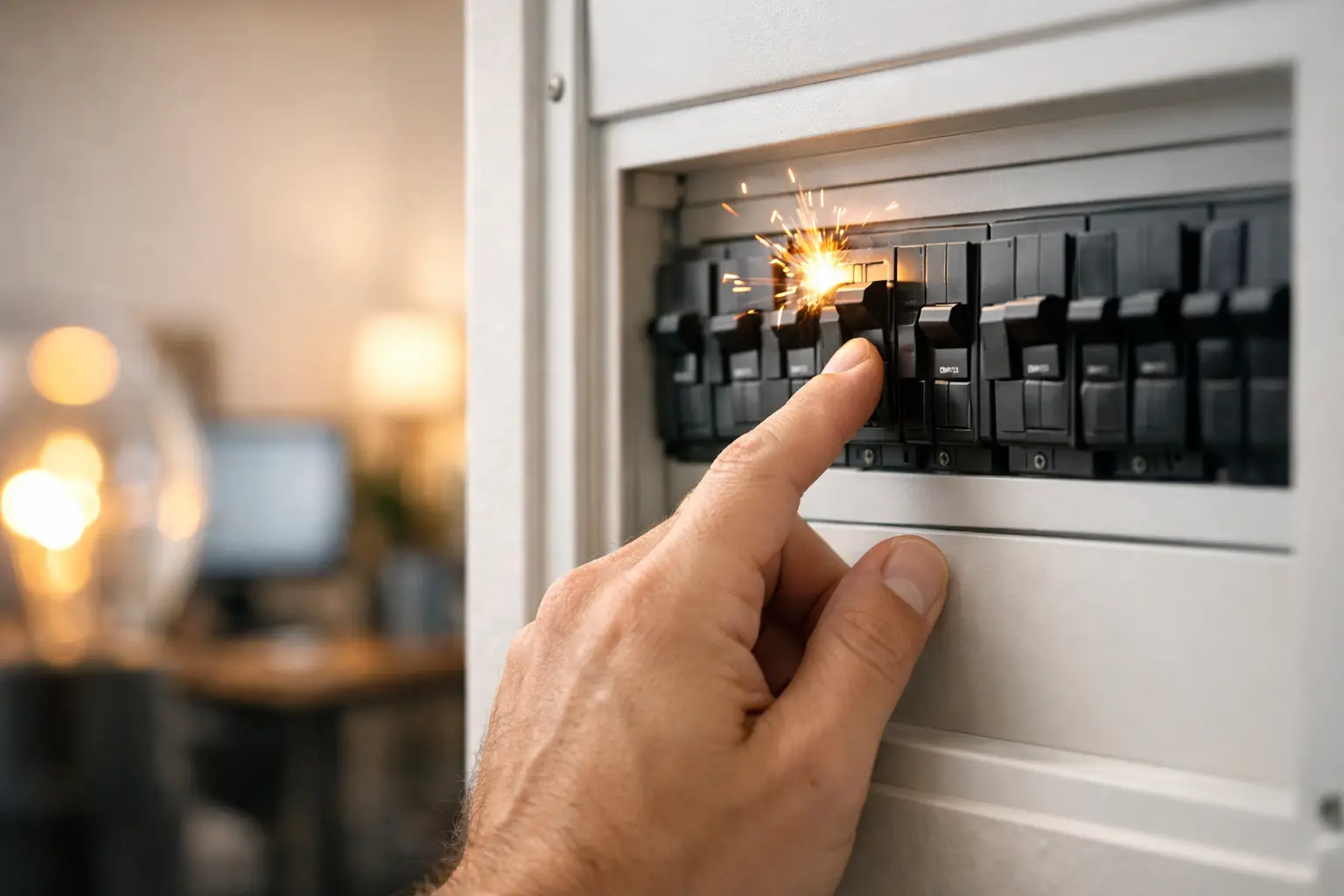
A breaker that trips once after a clear overload may have done exactly what it was designed to do. A breaker that trips repeatedly, trips the moment you reset it, or starts affecting essential equipment is telling you something needs attention. If you are asking why breaker keeps tripping, the answer is usually not that the breaker is “too sensitive.” It is reacting to excess current, a fault, or a condition that could overheat wiring or create a shock hazard.
The safest response is to stop resetting it over and over. Turn off or unplug the equipment on that circuit, make one careful reset attempt if there is no sign of damage, and pay attention to what happens next. A licensed electrician can trace the circuit, test the equipment and protective devices, and correct the actual cause instead of masking it.
Why Your Breaker Keeps Tripping
Circuit breakers protect conductors inside walls, ceilings, conduit, and equipment connections. They are sized to match the circuit wiring and are intended to open before the wiring gets dangerously hot. The reason matters because several problems can look the same at the panel while requiring very different repairs.
An overloaded circuit is common in older homes, offices with added equipment, and spaces that have changed use over time. A short circuit or ground fault is more urgent and can occur because of damaged wiring, moisture, a failed appliance, or a loose connection. Newer arc-fault and ground-fault breakers add another layer of protection, so they may also trip when they detect arcing or current leakage that a standard breaker would not recognize.
The pattern of the trip provides useful clues. Does it happen only when the microwave, space heater, printer, air compressor, or EV charger runs? Does it trip during rain? Does it reset and trip immediately with everything unplugged? Those details help narrow the diagnosis, but they do not replace electrical testing.
An Overloaded Circuit
An overload occurs when connected loads draw more current than the circuit is designed to carry. A 15-amp general-purpose circuit may handle lamps and electronics without trouble, then trip when a portable heater, hair dryer, toaster oven, or vacuum is added. High-wattage heating devices are frequent culprits because they draw substantial power continuously.
In a business setting, overloads often appear after a tenant upfit, equipment change, or workstation expansion. A circuit that once served a few computers may now be supplying monitors, printers, countertop appliances, point-of-sale equipment, or task lighting. The issue may be intermittent because not every device runs at the same time.
Unplugging or relocating one temporary load can be a reasonable short-term measure. It is not a long-term plan to rely on extension cords, power strips, or repeated breaker resets. The correct repair may involve redistributing loads, installing a dedicated circuit, or evaluating panel capacity before additional equipment is added.
A Short Circuit or Damaged Wiring
A short circuit happens when an energized conductor contacts a neutral conductor or another unintended path. It often causes a breaker to trip immediately or very soon after being reset. Damaged appliance cords, pinched wiring, loose connections, rodent damage, failed fixtures, and work performed behind walls can all contribute.
Do not continue resetting a breaker that trips immediately, especially if you notice a burning odor, discoloration, buzzing, heat at an outlet or panel, sparks, or a damaged cord. Leave the circuit off and arrange service. These are conditions where finding the fault matters more than restoring power quickly.
A licensed electrician may isolate sections of the circuit, inspect accessible connections, test insulation and continuity, and evaluate the connected equipment. Clean troubleshooting is more efficient than replacing parts by guesswork, particularly when a problem is hidden in a junction box, fixture, piece of equipment, or conduit run.
Ground Faults and Moisture Problems
Ground faults occur when electricity takes an unintended path to ground. Ground-fault circuit interrupters, commonly called GFCIs, are designed to trip quickly to reduce shock risk. They are commonly used in kitchens, bathrooms, garages, exterior areas, utility spaces, and commercial locations where moisture or grounded surfaces are more likely.
If a GFCI breaker or outlet trips after rain, pressure washing, a plumbing leak, or use of outdoor equipment, moisture may be involved. Exterior receptacles, landscape lighting, crawl spaces, damaged covers, and equipment connections deserve inspection. Drying a visible surface is not always enough, since water can remain inside a box or fitting.
A GFCI can also trip because of a failing appliance. If the circuit holds with an appliance unplugged and trips when it is reconnected, stop using that equipment until it can be repaired or replaced. Do not bypass GFCI protection to keep equipment running.
Arc-Fault Breakers and Loose Connections
Many newer residential circuits use arc-fault circuit interrupters, or AFCIs. These breakers are designed to detect arcing patterns that can occur with damaged cords, loose terminals, worn outlets, or compromised wiring. They are valuable protection, but their troubleshooting requires care because the problem may be intermittent.
A loose outlet, switch, breaker terminal, or splice can generate heat and arcing without creating a constant outage. You may notice a light flicker, a crackling sound, a warm cover plate, or a breaker that trips when a cord is moved. Those signs warrant prompt electrical service. Tightening a connection may sound simple, but the circuit must be properly de-energized and the underlying damage assessed.
First Checks You Can Make Safely
Before calling for service, note which breaker tripped and what was operating when it happened. Turn off lights and unplug portable devices served by that circuit. Reset the breaker once by moving it fully to OFF, then back to ON. Some breakers sit between positions when tripped, so simply pushing it toward ON may not reset it.
If it stays on, reconnect items one at a time. When the breaker trips again, the last item connected may be involved. This is useful information for the electrician, though it does not prove the item is the only issue. A shared circuit, worn receptacle, or wiring fault can be part of the problem as well.
Keep the breaker off and call for help if it will not reset, trips with everything unplugged, trips repeatedly, or is accompanied by heat, smoke, a burning smell, water exposure, or visible damage. For a commercial facility, also consider what the circuit supports. Refrigeration, life-safety-related systems, IT equipment, production equipment, and tenant operations may require a coordinated response to limit disruption safely.
Repairs That Solve the Cause, Not the Symptom
Replacing a breaker with a larger one is not an acceptable fix unless a licensed electrician has verified that the circuit conductors, panel, and connected equipment are designed for that rating. An oversized breaker can allow wiring to overheat before it trips. Likewise, replacing a protective breaker with a standard model to stop nuisance tripping can remove a required layer of safety.
The proper solution depends on the diagnosis. A failed appliance may need repair. A damaged receptacle, fixture, cord, or splice may need replacement. A heavily used kitchen, garage, workshop, office, or equipment area may need a new dedicated circuit. An older panel may need evaluation if there is insufficient capacity for a remodel, new appliance, or Level 2 EV charger.
For EV charging, repeated tripping can point to circuit loading, charger settings, connection issues, or equipment faults. Charging equipment should be installed on a correctly sized dedicated circuit, with the electrical system evaluated for the continuous load. This is not an area for adapters or improvised wiring.
Stamper Electrical LLC provides licensed diagnostics, repairs, dedicated circuits, panel upgrades, and equipment power work for homes and businesses across Wake County. Clear notes about when the breaker trips and what it serves can help make the service visit faster and more targeted.
A breaker is a warning device, not an inconvenience to work around. Leave it off when the signs point to a fault, protect the people and equipment depending on that circuit, and have the cause identified before the next reset becomes a bigger problem.