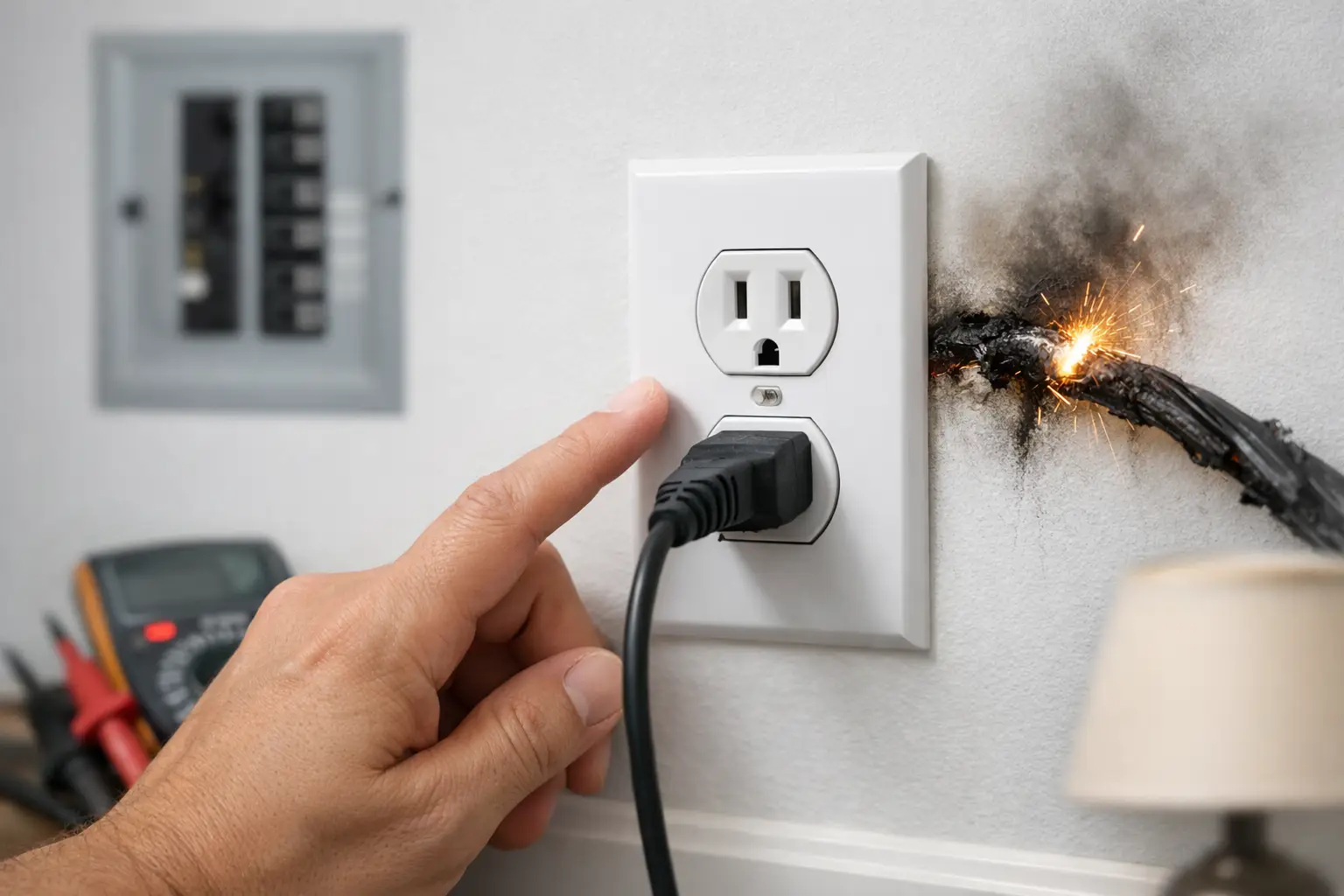
A receptacle that suddenly has no power can stop a kitchen appliance, home office, TV, or charger without much warning. The four reasons outlets stop working are often straightforward, but the source is not always the outlet you can see. A tripped protective device, a failed connection upstream, or a wiring problem elsewhere on the circuit can all leave one or several outlets dead.
The safest approach is to identify the scope of the problem, perform only basic checks that do not expose wiring, and call a licensed electrician when the cause is unclear. An outlet that has overheated, sparks, feels loose, or repeatedly loses power needs prompt professional attention.
Four Reasons Outlets Stop Working
1. A circuit breaker has tripped
Your electrical panel uses circuit breakers to shut off power when a circuit draws more current than it should or develops a fault. A breaker may trip after too many high-demand devices run on the same circuit, such as a space heater, microwave, hair dryer, or window AC unit. It can also trip because of a damaged appliance, a short circuit, or a problem in the branch wiring.
A tripped breaker does not always look fully switched to the OFF position. Many breakers rest in a middle position. To reset one, turn it firmly all the way OFF first, then turn it back ON. If it immediately trips again, leave it off. Repeated resetting can worsen damage if the circuit has a short, an overloaded condition, or a failing electrical component.
A single dead outlet may be on the same circuit as other rooms, exterior receptacles, garage outlets, or bathroom outlets. Check nearby lights and receptacles before assuming the panel is the issue. Knowing what else lost power gives an electrician useful diagnostic information.
2. A GFCI outlet has tripped
Ground-fault circuit interrupter, or GFCI, protection is common in locations where moisture is a concern, including kitchens, bathrooms, garages, laundry rooms, unfinished basements, crawl spaces, and exterior areas. A GFCI device monitors the flow of electricity and shuts off quickly when it detects a potential ground fault.
One GFCI outlet may protect several standard outlets downstream. That means a dead garage outlet could be controlled by a GFCI in the garage, bathroom, kitchen, laundry area, or another nearby location. Look for receptacles with TEST and RESET buttons and press RESET once. If the button will not stay engaged or the outlet trips again, do not force it.
GFCI protection can trip from a wet exterior cover, a failing appliance, a damaged cord, moisture in a box, or a wiring problem. In older homes, identifying which receptacles are protected by which GFCI device can take methodical testing. This is one reason an outlet repair may involve more than replacing the visible receptacle.
3. The outlet or a connection has failed
Outlets wear out. Repeated use can loosen the internal contacts that hold a plug in place, and a loose plug connection can create heat. A receptacle can also fail after years of use, after a surge event, or because a wire connection behind it has loosened.
Warning signs include plugs that fall out, a warm faceplate, discoloration, a burning odor, crackling sounds, or a receptacle that works only when a plug is held at a certain angle. Turn off the circuit at the panel and stop using that outlet if any of these conditions are present. Do not try to tighten wiring or replace the device unless you are qualified to do the work.
The failed point may be an outlet upstream rather than the dead one. In some installations, power enters one outlet box and continues to the next. If a connection opens at the first box, every outlet after it may lose power. A licensed electrician can trace the circuit, inspect connections, replace damaged devices, and verify that the repair is properly grounded and secure.
4. There is a wiring or circuit-design problem
Some outlet failures point to a larger issue within the circuit. Rodent damage, a nail or screw through a cable during a renovation, corrosion, damaged underground or exterior wiring, and old or deteriorated connections can interrupt power. So can an overloaded circuit that was never intended to support modern appliance loads.
A common example is a home office or entertainment area added to an existing general-use circuit. Multiple monitors, computers, printers, chargers, and portable heaters can push that circuit beyond its practical capacity. In a kitchen, garage, workshop, or utility area, equipment with heating elements or motors can create similar problems.
The right repair depends on the diagnosis. Sometimes the answer is repairing a damaged cable or replacing a failed junction connection. Other times, the better long-term solution is a new dedicated circuit for a freezer, microwave, disposal, sump pump, workshop tool, or EV charger. A dedicated circuit helps protect both the equipment and the rest of the electrical system from avoidable overloads.
What You Can Safely Check Before Calling
Start with the simple, non-invasive checks. Unplug anything connected to the dead outlet, especially devices that may have caused an overload. Test the outlet with a lamp or another small device you know works. Then check for a tripped breaker and reset any nearby GFCI outlet once.
Also look around the affected area. Are nearby outlets dead? Is a wall switch controlling the receptacle? Are lights on the same circuit flickering or dimming? Is the outlet in a damp location, outdoors, or near a sink? These details help narrow down whether the issue is localized or affects the circuit more broadly.
Do not remove the outlet cover, pull the receptacle out of the box, or probe the wiring with improvised tools. Turning off a breaker reduces risk, but it does not confirm that every conductor in a box is de-energized. Electrical diagnosis requires proper testing equipment and an understanding of how the circuit is configured.
When an Outlet Problem Needs a Licensed Electrician
Schedule service promptly if a breaker or GFCI will not reset, the outlet has visible damage, or power drops in and out. You should also call for help if an outlet is warm, buzzing, sparking, smells burned, or has caused a plug or faceplate to discolor. Those symptoms can indicate overheating at a connection and should not be treated as a minor inconvenience.
For commercial spaces, a dead outlet can affect point-of-sale equipment, network hardware, breakroom appliances, tenant operations, or equipment power. The quickest dependable solution is not always the nearest repair. A proper diagnosis should confirm the condition of the circuit, identify the root cause, and account for the load the space needs to support going forward.
Stamper Electrical provides outlet troubleshooting, repairs, dedicated circuits, panel work, and commercial electrical support throughout Wake County. Clean workmanship and clear communication matter when a small electrical failure is disrupting a home, tenant space, or facility.
If an outlet has stopped working, resist the urge to keep resetting it or work around it with extension cords. A careful diagnosis now can prevent a repeat failure and give the circuit the capacity and protection it needs.